Sound Kits

Welcome to our guide on the best MIDI control surfaces for your home studio. Whether you’re a seasoned producer or just starting out, a MIDI control surface can greatly enhance your workflow and productivity. Designed to work with popular music software and digital audio workstations, these devices provide tactile control over virtual instruments, effects, and mixing parameters.
In this article, we’ll provide a comprehensive buying guide and review some of the top MIDI control surfaces on the market. We understand that choosing the right device can be daunting, especially with so many different models available. That’s why we’ve put together this guide to help you make an informed decision. So, whether you’re looking for a basic controller or a more advanced device with extensive functionality, we’ve got you covered.
Our reviews are based on extensive research and hands-on testing, so you can be sure that our recommendations are accurate and unbiased. We’ll discuss the features, pros, and cons of each device, as well as their suitability for a home studio setup. So, without further ado, let’s dive into the world of MIDI control surfaces!
Akai Professional MPK Mini MK3
What is a MIDI Control Surface?
In simple terms, a MIDI control surface is a device that allows you to control audio software or hardware using MIDI (Musical Instrument Digital Interface) communication. It is essentially an interface between you and your computer or other MIDI-enabled device.
MIDI control surfaces come in all shapes and sizes, with varying numbers of buttons, knobs, faders, and other controls. They can be used to control everything from virtual instruments and effects to mixers and recording software.
There are many different types of MIDI control surfaces available, each with its own unique set of features and capabilities. Some are designed for use in a studio setting, while others are better suited for performance and live use.
Benefits of Using a MIDI Control Surface in Your Home Studio
If you’re looking to take your home studio setup to the next level, investing in a MIDI control surface is a wise choice. Here are some of the benefits of incorporating a MIDI control surface into your home studio:
- Improved Workflow: A MIDI control surface allows you to control your software instruments and DAW more efficiently. The tactile controls make it easier to adjust parameters and create music more intuitively.
- Increased Creativity: Using a MIDI control surface can inspire you to make music in new ways. The ability to play and manipulate sounds with physical controls can lead to happy accidents and creative breakthroughs.
- More Expressive Performances: Playing software instruments with a MIDI controller often results in more expressive performances. You can use the velocity-sensitive pads and keys to add dynamics and nuance to your playing.
- Easier Mixing and Automation: A MIDI control surface can also make it easier to mix and automate your music. You can use the faders and knobs to adjust levels and apply effects in real-time.
Overall, a MIDI control surface can help you work more efficiently, be more creative, and create better music. It’s a worthwhile investment for any home studio setup.
Factors to Consider When Choosing a MIDI Control Surface
When selecting a MIDI control surface for your home studio, there are several factors to consider. These factors will help you choose the best model for your needs and budget.
Size
One of the first things to consider is the size of the MIDI control surface. Think about the amount of space you have in your home studio and the number of controls you need. If you have limited space, a smaller control surface may be more appropriate. On the other hand, if you require a large number of controls, a larger control surface may be necessary.
Number of Controls
Another important factor to consider is the number of controls on the MIDI control surface. Think about the type of music you produce and the number of parameters you need to control in your DAW. If you produce electronic dance music (EDM), for example, you may require a control surface with a large number of knobs and faders. If you produce acoustic music, on the other hand, you may require a control surface with fewer controls.
Compatibility
It is also important to consider the compatibility of the MIDI control surface with your DAW and operating system. Make sure the model you choose is compatible with your preferred software and platform. If you use multiple DAWs or platforms, consider a control surface with universal compatibility.
Price
Price is another important factor to consider when choosing a MIDI control surface. Set a budget and stick to it. Keep in mind that the more features a control surface has, the higher its price is likely to be. However, it is possible to find a high-quality control surface at a reasonable price if you do your research.
Best MIDI Control Surfaces for Home Studio – Overview
If you’re looking to add more control to your home studio setup, a MIDI control surface could be just what you need. We’ve put together a list of the top MIDI control surfaces on the market, each with its own unique set of features and benefits.
Our reviews cover a range of options, from budget-friendly models to top-of-the-line surfaces with extensive features. Whatever your needs and budget, you’re sure to find a MIDI control surface that will enhance your home studio setup.
Below is an overview of the models we’ll be reviewing:
| MIDI Control Surface | Price | Key Features |
|---|---|---|
| Akai MPK Mini MkIII | $99 | 25 mini keys, 8 MPC pads, 8 assignable knobs |
| Novation Launchkey Mini | $95 | 25 mini keys, 16 RGB pads, 8 rotary knobs |
| Behringer X-Touch Mini | $99 | 8 motorized faders, 16 rotary knobs, 39 illuminated buttons |
| Korg NanoKONTROL2 | $69 | 8 faders, 8 knobs, 24 buttons |
| Arturia MiniLab MkII | $79 | 25 mini keys, 16 rotary knobs, 8 pads, touchstrips |
| Native Instruments Komplete Kontrol M32 | $139 | 32 compact keys, OLED display, Smart Play features |
Now, let’s dive into the details of each control surface and see which one might be the best fit for your home studio needs.
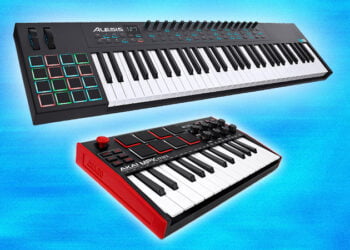
Akai MPK Mini MkIII
Akai Professional MPK Mini MK3
The Akai MPK Mini MkIII MIDI control surface is a compact and portable device that packs a punch in terms of functionality. It features 25 velocity-sensitive keys, eight backlit MPC-style drum pads, and eight assignable Q-Link knobs. The device also comes with a built-in arpeggiator, note repeat, and a variety of controls for manipulating virtual instruments and effects.
The device is incredibly easy to set up and use, making it a great option for beginners or those with limited space in their home studio. The keys and drum pads are both responsive and feel great to play, providing an immersive experience for the user.
One potential downside of the Akai MPK Mini MkIII is the lack of modulation and pitch bend wheels, which may be an issue for some users. Additionally, the device’s small size may not be suitable for those with larger hands or who prefer a more substantial control surface.
Overall, the Akai MPK Mini MkIII is a fantastic option for those in need of a compact and versatile MIDI control surface for their home studio. Its wide range of features and user-friendly design make it a top pick for both beginners and more experienced producers alike.
Novation Launchkey Mini
Novation Launchkey Mini 25 MK4
Novation Launchkey Mini is a compact MIDI control surface that is perfect for a small home studio setup or for musicians on the go. It features 25 velocity-sensitive keys, eight knobs, and 16 backlit pads that are assignable and can be used to trigger clips, play drums, and control virtual instruments.
The Launchkey Mini is compatible with both Mac and PC and is powered via USB. It also comes with Ableton Live Lite, a digital audio workstation that provides an excellent platform for recording and producing music.
One of the standout features of the Launchkey Mini is the InControl technology that seamlessly integrates with Ableton Live. This allows for easy and intuitive control over the DAW without the need for complex mapping. The control surface also features a dedicated arpeggiator mode and a fixed chord mode that simplifies chord progressions.
The Launchkey Mini has a sleek, compact design that makes it easy to take with you on the go. It’s also incredibly affordable, making it an excellent choice for musicians on a budget who still want a high-quality control surface for their home studio.
Overall, the Novation Launchkey Mini is an excellent MIDI control surface that provides a lot of functionality in a compact and affordable package. It’s perfect for home studio setups or musicians who are always on the go.
Behringer X-Touch Mini
Behringer X-TOUCH MINI
The Behringer X-Touch Mini is a compact MIDI control surface that offers a lot of functionality for its small size. It has eight rotary encoders, 16 illuminated buttons, and a touch strip for pitch bend and modulation. The X-Touch Mini connects to your computer via USB and is compatible with most major DAWs, including Ableton Live, Logic Pro X, and Pro Tools.
One of the standout features of the Behringer X-Touch Mini is its robust build quality. Despite its size, it feels sturdy and well-built, which is great if you plan to take it on the road. The illuminated buttons are also a nice touch, especially when working in a dimly lit studio.
Another highlight of the X-Touch Mini is its integration with Behringer’s X-Touch Universal Control Surface line. If you have other X-Touch controllers, the X-Touch Mini can be used as an extension of those devices, allowing you to expand your control surface and workflow.
Overall, the Behringer X-Touch Mini is an excellent choice for anyone looking for a compact and versatile MIDI control surface. It offers a lot of features and functionality in a small package, making it a great option for home studio setups or on-the-go production.
Korg NanoKONTROL2
Korg nanoKONTROL2 Slim-Line USB Control Surface
The Korg NanoKONTROL2 is a compact and affordable MIDI control surface that is perfect for musicians on a budget. It features eight faders, eight knobs, and 24 buttons, allowing you to control your music software with ease.
The NanoKONTROL2 is compatible with a wide range of music software, including Ableton Live, GarageBand, and Logic Pro X. It also features a dedicated transport section, making it easy to control your DAW’s playback, recording, and stop functions.
One of the standout features of the NanoKONTROL2 is its compact size. It measures just 12.8 inches wide and 3.27 inches deep, making it the perfect size for a home studio setup. It is also lightweight, weighing just 0.65 pounds, so you can easily take it with you on the go.
Despite its affordable price tag, the NanoKONTROL2 is built to last. It features a sturdy construction and high-quality components, ensuring that it will provide reliable performance for years to come.
Arturia MiniLab MkII
Arturia MiniLab MkII
The Arturia MiniLab MkII is a compact and versatile MIDI control surface that is perfect for home studio setups. It features 25 velocity-sensitive keys, 16 rotary encoders, and eight backlit pads that can be used for triggering samples and drum patterns. The MiniLab MkII also comes with software instruments and a DAW to get you started right away.
One of the standout features of the Arturia MiniLab MkII is its portability. It’s small enough to take with you on the go, making it an excellent choice for musicians who want to create music on the move. The control surface is also USB-powered, which means you don’t need to worry about an external power source.
When it comes to build quality, the Arturia MiniLab MkII is impressive. Its construction is sturdy and durable, making it an excellent investment for home studio owners. The keys feel great to play, and the encoders and pads are responsive and tactile.
Overall, the Arturia MiniLab MkII is an excellent choice for anyone looking for a compact and versatile MIDI control surface for their home studio. Its portability, build quality, and functionality make it a standout option for musicians and producers alike.
Native Instruments Komplete Kontrol M32
Native Instruments Komplete Kontrol M32
The Native Instruments Komplete Kontrol M32 MIDI control surface is a compact and portable device that packs a lot of power. It is designed to work seamlessly with Native Instruments’ Komplete software, giving users complete control over their virtual instruments and effects.
This MIDI control surface features 32 compact keys with a responsive synth-action that offers a comfortable playing experience. It also has eight touch-sensitive control knobs, one touch strip for pitch and modulation control, and dedicated buttons for octave up/down, scale mode, and arpeggiator.
One of the standout features of the Komplete Kontrol M32 is its integration with Native Instruments’ Kontrol software. This software allows for quick and easy browsing through thousands of sounds and presets, with the ability to load them directly from the control surface. It also provides access to powerful performance tools such as Smart Play, which allows for easy chord and scale playing.
Pros
- Compact and portable size
- Integration with Native Instruments’ Kontrol software
- Responsive synth-action keys
- Dedicated buttons for octave up/down, scale mode, and arpeggiator
Cons
- Limited control knobs compared to other MIDI control surfaces
- May not be as versatile for non-Native Instruments software
Overall, the Native Instruments Komplete Kontrol M32 is an excellent choice for producers and musicians who want a compact and powerful MIDI control surface for their home studio. Its integration with Native Instruments’ Kontrol software provides easy access to a vast array of sounds and presets, making it a valuable tool for both beginners and professionals alike.
Buying Guide for MIDI Control Surfaces
When it comes to choosing a MIDI control surface for your home studio, there are several factors to consider. Here we’ve compiled a buying guide to help you make an informed decision.
1. Size
MIDI control surfaces come in various sizes, from compact models with just a few knobs and buttons to larger devices with a multitude of controls. Consider how much desk space you have and how many controls you need to access regularly.
2. Number of Controls
The number of controls on a MIDI control surface can range from just a few to dozens. Consider what functions you need to control and how many knobs, faders, and buttons you require.
3. Compatibility
Ensure that the MIDI control surface you choose is compatible with your computer and music software. Some models come with software that may only work with certain operating systems, so check compatibility before purchasing.
4. Price
MIDI control surfaces can vary greatly in price, from affordable budget options to high-end models. Consider how much you are willing to spend and what features are essential for your needs.
5. Brand Reputation
Consider the reputation of the brand before purchasing a MIDI control surface. Look for reviews and recommendations from other musicians and audio professionals.
6. Ergonomics
Consider the layout and ergonomics of the MIDI control surface. Ensure that it is comfortable to use for extended periods of time and that the controls are easily accessible.
By considering these factors, you can narrow down your options and choose the best MIDI control surface for your home studio setup.
FAQs
Here are some frequently asked questions about MIDI control surfaces in a home studio setup:
What is a MIDI control surface?
A MIDI control surface is a piece of hardware used to control digital audio workstations (DAWs) and virtual instruments. It functions through the MIDI protocol, allowing for user control over various parameters of the software being used.
What are the benefits of using a MIDI control surface in a home studio?
Using a MIDI control surface in a home studio can improve workflow, increase creativity, and provide a more tactile and intuitive approach to music production. It can also help streamline the recording and mixing process, allowing for quicker and more efficient production.
What factors should I consider when choosing a MIDI control surface?
Some important factors to consider when choosing a MIDI control surface include size and portability, number of controls and their functionality, compatibility with your software and operating system, build quality, and price.
What are some of the top MIDI control surfaces for a home studio?
Some of the top MIDI control surfaces for a home studio include the Akai MPK Mini MkIII, Novation Launchkey Mini, Behringer X-Touch Mini, Korg NanoKONTROL2, Arturia MiniLab MkII, and Native Instruments Komplete Kontrol M32.
Do I need any special software to use a MIDI control surface?
Most MIDI control surfaces will work with any compatible DAW software. Some may require specific drivers or software to be installed on your computer, so be sure to check the manufacturer’s website for any necessary downloads or updates.
Are MIDI control surfaces easy to set up and use?
Setting up a MIDI control surface can vary depending on the model and software being used, but most are designed to be user-friendly and intuitive. There are plenty of resources available online, including manuals and tutorials, to help guide you through the process.